
Communication Skills That Win Interviews
Last updated August 29, 2026
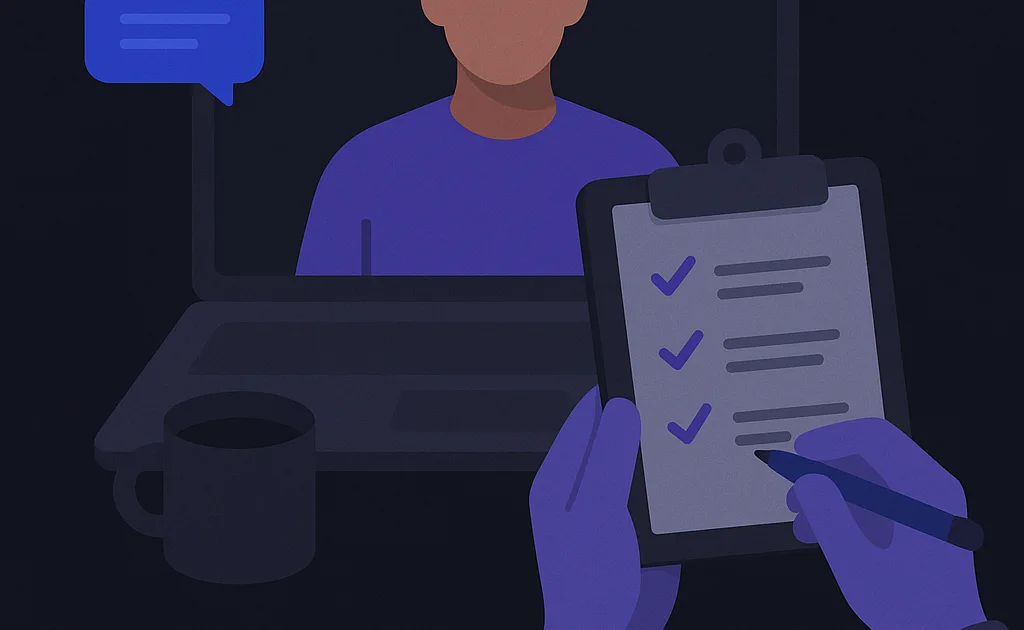
Here's an uncomfortable truth: in most interviews, communication skill outweighs raw knowledge. Two candidates with identical experience walk in; the one who structures answers, lands endings, and makes the interviewer's job easy walks out with the offer. The good news is that interview communication is a small set of learnable mechanics, not charisma.
The key idea: great interview communication is signposted. Tell them what you're about to say, say it in a labelled structure, then stop. Rambling isn't a knowledge problem — it's a missing exit.
The five mechanics
- Headline first. Answer the question in the first sentence, then support it. "Yes — I led that migration, and here's how." Never make the interviewer dig for your point.
- Signpost your structure. "There were three challenges: timing, data quality, and adoption." Now the listener has a map and can relax — they know where you are at every moment.
- Land the ending. The single most-common interview failure is the fade-out: "...and, yeah, so, that was basically it." End on the result and the lesson, full stop. STAR exists largely to force this.
- Pause instead of filling. A two-second silence reads as thoughtfulness; "um" chains read as uncertainty. The pause is always shorter to them than it feels to you.
- Check in. "Does that answer it, or would you like more depth on the technical side?" This one sentence makes you collaborative and prevents the dreaded five-minute monologue.
Adapting to your listener
The same answer needs different depth per audience. Engineers want the "how"; managers want the "why" and the trade-offs; executives want scope and outcome. Watch for signals — glazing eyes mean zoom out; leaning in means zoom in. When in doubt, give the summary and offer the depth: "The short version is X — happy to go deeper on any part." Building this sensitivity is exactly what rapport is made of.
Here's an exercise that improves spoken structure faster than speaking alone: before your next practice session, write one answer out fully, then delete a third of it. What remains is your structure stripped of padding — headline, two or three labelled points, result, lesson. Now say that version out loud. Writing forces a linear logic that speech lets you skip, and the deletion step shows you exactly where your ramble lives. Do this for your five most likely questions and the tightened structure carries into every other answer, because the habit — headline, signposts, landing — transfers even when the content doesn't.
What to avoid
- Answering the question you wished they'd asked. If you're unsure, clarify — it reads as rigor, not weakness.
- Jargon with mixed audiences. Translate or briefly define; nothing kills a cross-functional panel faster.
- Speed-talking. Nervous pace destroys comprehension. Slow twenty percent and everything improves at once.
FAQ
How long should answers be? Roughly one to two minutes for behavioral stories, shorter for factual questions. When the interviewer wants more, they'll ask — follow-ups are a sign of engagement, not failure.
How do I practice this specifically? Record yourself answering common questions and score only these five mechanics. Communication improves faster than almost any other interview skill because the feedback is so immediate.
Put this into practice
Continue with the Aissence workflow this guide supports.