
Product Manager Interview Questions and Answer Outlines
By Kieron
Last updated October 4, 2026
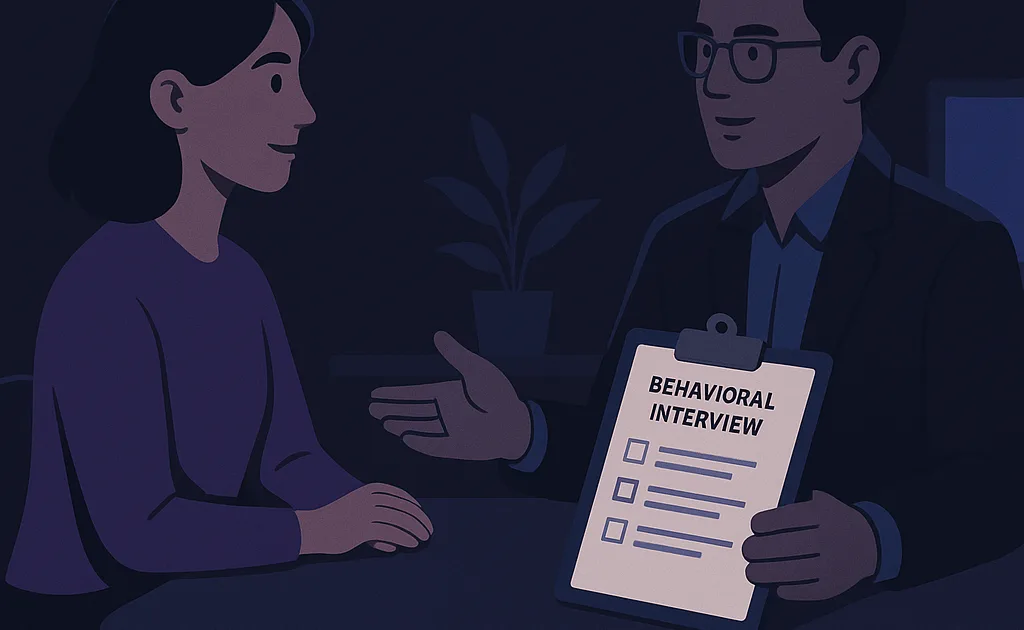
Product manager interviews test how you think: product sense, metrics, execution, strategy, and how you work with people. The questions below are grouped by what they test, with the shape of a strong answer. Frameworks help you organize a response, but interviewers can tell when a framework is replacing thinking. Use structure to be clear, and spend most of your time on the specifics of the product and the user.
The usual interview loop
- Recruiter screen: background, motivation, scope of past products.
- Product sense / design round: design or improve a product for a user.
- Analytical / metrics round: investigate a change or define success.
- Execution / behavioral round: past projects, prioritization, stakeholders.
- Strategy or leadership round for senior roles.
Product sense questions
- "Improve a product you use daily." Strong answer: pick one user group and say why, name two or three real problems they face, choose one, propose a solution, and say how you would know it worked.
- "Design a product for X." Strong answer: clarify the goal, segment users, pick a segment, list their needs, generate a few ideas, pick one with a stated criterion.
- "Why do you like this product, and what would you change?" Strong answer: specific observations, a clear user, and one prioritized change with a trade-off.
Metrics and analytical questions
- "Weekly active users dropped 8%. What do you do?" Strong answer: first check data quality and tracking changes, then segment (platform, cohort, geography, funnel step), then look at recent releases and external events, then form hypotheses to test.
- "How would you measure success for a new onboarding flow?" Strong answer: one primary metric (for example the percentage of new users who complete a key action within a window), a guardrail (such as support tickets or retention), and what result would make you stop.
- "Which metric would you choose for a marketplace?" Strong answer: say what the business needs (liquidity, repeat transactions), choose a metric that reflects both sides, and mention how it could be gamed.
Prioritization and execution
- "You have three roadmap items and capacity for one." State a criterion (impact, effort, risk, dependency) and the trade-off, say what you would not do, and how you would communicate it.
- "Tell me about a time you shipped late." Describe the cause, the options you gave stakeholders, what you cut, and what you changed afterwards.
- "Tell me about a time engineering disagreed with you." Show that you treated the pushback as information and what changed.
Worked answer: "Improve a product you use daily"
Outline of a strong answer for a calendar app: Choose one user: people who schedule meetings across time zones. List problems: finding a time that works for everyone, remembering who is in which zone, and rescheduling cascades. Choose to focus on finding a time. Propose showing each attendee's working hours as a heat map on the scheduling screen and suggesting the three least inconvenient slots. Define success: fewer reschedules per meeting and a shorter time from invite to accepted. Name a risk: privacy of working hours, mitigated by sharing only availability, not details.
Why it works: A deliberate user choice, a specific problem, a solution that follows from it, and a measurable outcome with a risk.
Behavioral questions to prepare
- Tell me about a product decision you are proud of and one you would change.
- Describe how you influenced someone senior without authority.
- Tell me about a feature that did not work, and what you did next.
- How do you work with a designer or engineer who disagrees with your roadmap?
Common mistakes
- Jumping to features before choosing a user and a problem.
- Naming a metric without saying why it is right or how it could be gamed.
- Treating a framework as the answer instead of a tool.
- Telling stories in which you are the hero and the team is scenery.
Prepare in three sessions
Session one: a mixed run from your resume. Session two: product sense and metrics questions repeated until each has a clear structure. Session three: your two best stakeholder stories against a two-minute timer. The product manager practice page lists more questions, and the STAR method guide covers the stories.
Frequently asked questions
Do I need a framework for product sense questions?
A light structure helps you stay organized, but interviewers care more about your choices and reasoning than the framework's name. Do not recite one.
How technical do I need to be?
It depends on the product. Be able to discuss how systems work well enough to make trade-offs with engineers. For technical product roles expect more detail.
How should I prepare for metrics questions?
Practice segmenting a change, choosing a primary metric and a guardrail, and describing what you would do with the answer.
What if I have no product management experience?
Use adjacent experience: analysis, projects you led, side projects, or customer-facing work. Show the product skills in those stories: choosing a problem, prioritizing, and measuring.
Put this into practice
Continue with the Aissence workflow this guide supports.