
25 UX Designer Interview Questions & Portfolio Tips
Last updated August 29, 2026
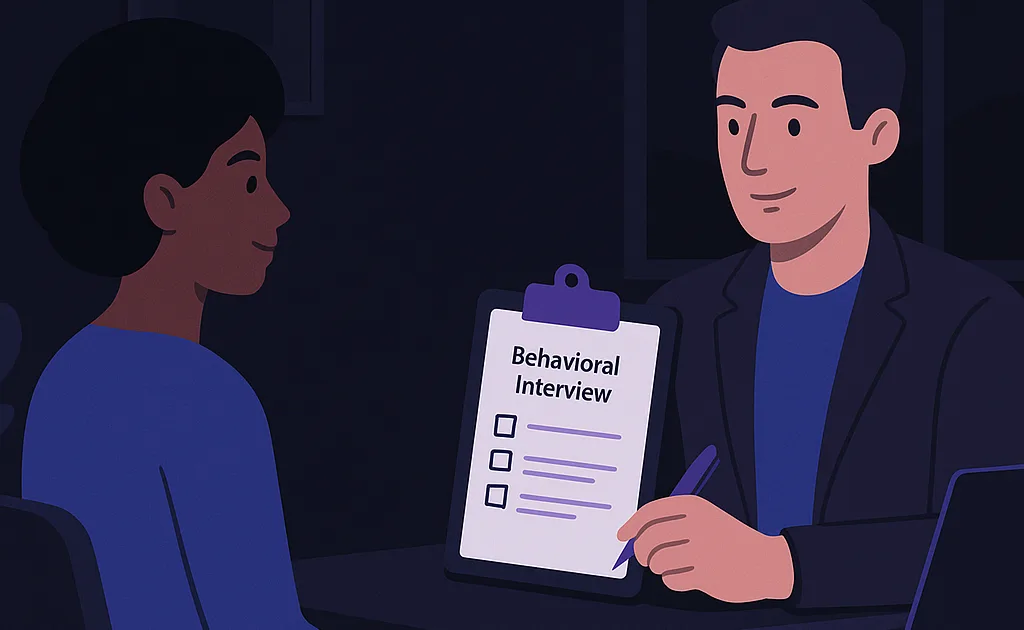
UX interviews in 2026 are portfolio interviews. The conversation, the whiteboard exercise, the app critique — all of it orbits one question: can you explain the thinking behind your design decisions? Beautiful screens open the door; articulate reasoning about users, constraints, and trade-offs is what gets you hired.
Interviewers are hiring your judgment, not your deliverables. A polished case study with no visible reasoning reads as decoration. A messier project where you explain why you killed your favourite idea after usability testing — that's the candidate who gets the offer. Process honesty beats outcome polish every time.
Here's what gets evaluated, the questions grouped by interview format, a structure for case-study walkthroughs, and the mistakes that make strong designers look junior.
What interviewers are scoring
- Problem framing. Do you start from a user and business problem, or from a solution you fell in love with?
- Research instinct. How do you learn what users need — and how do you handle having no research budget?
- Iteration honesty. Did the design evolve? Can you show what changed and what evidence drove each change?
- Collaboration. How you negotiate with engineers on feasibility and with product on scope.
- Craft. Yes, visual quality still matters — but as the floor, not the ceiling.
The questions you'll face, by format
Portfolio walkthrough: "Take us through a project." Expect interruptions — the interruptions are the interview. "Why this layout?" "What did users struggle with?" "What would you do differently?"
Whiteboard / design exercise: "Design a way for users to do X." They're scoring how you scope, what assumptions you state, and whether you ask about constraints before drawing.
App critique: "Pick an app you admire and critique it." Have one ready — and critique something you genuinely use, with specific friction points, not generic praise.
Behavioural: "Tell me about a time an engineer said your design couldn't be built." "Describe a time research contradicted your instinct."
The case-study narrative structure
Structure each portfolio story in five beats, and rehearse a two-minute and a ten-minute version of each:
- The problem. Who hurt, how you knew, and why the business cared.
- The constraints. Timeline, tech limits, stakeholder landscape. Constraints make your decisions legible.
- The turning points. The two or three moments where evidence changed your direction — a test, an insight, a constraint that forced invention.
- The outcome. What shipped and how you knew it worked, stated honestly — qualitative feedback counts.
- The reflection. What you'd do differently. Never skip this; it's where seniority shows.
Common mistakes
- Showing final screens with no visible process — no sketches, no failed directions, no reasoning.
- Claiming sole credit for team work. Interviewers probe "what was yours?" and inconsistency here is disqualifying.
- Presenting research as a ritual ("we did five interviews") without saying what it changed.
- No story about a design that failed or got cut. Immaculate portfolios read as curated, not candid.
FAQ
I have no commercial projects yet — can personal work carry a portfolio? Yes, if the thinking is real. Redesign something you actually use, do genuine usability tests with real people, and show the evidence honestly. Fabricated "client work" gets spotted fast.
How do I handle the design exercise if I get stuck? Narrate the stuck-ness: "I'm torn between two directions; here's the trade-off I'd test first." Thinking aloud under uncertainty is exactly the job.
If your work spans screens and platforms, the mobile app interview guide covers the platform constraints your interviewer may probe. Rehearse the walkthrough — especially surviving interruptions — with mock interview practice.
Put this into practice
Continue with the Aissence workflow this guide supports.