
Linked Lists: Interview Problems & Solutions
430 words · Reviewed for accuracy
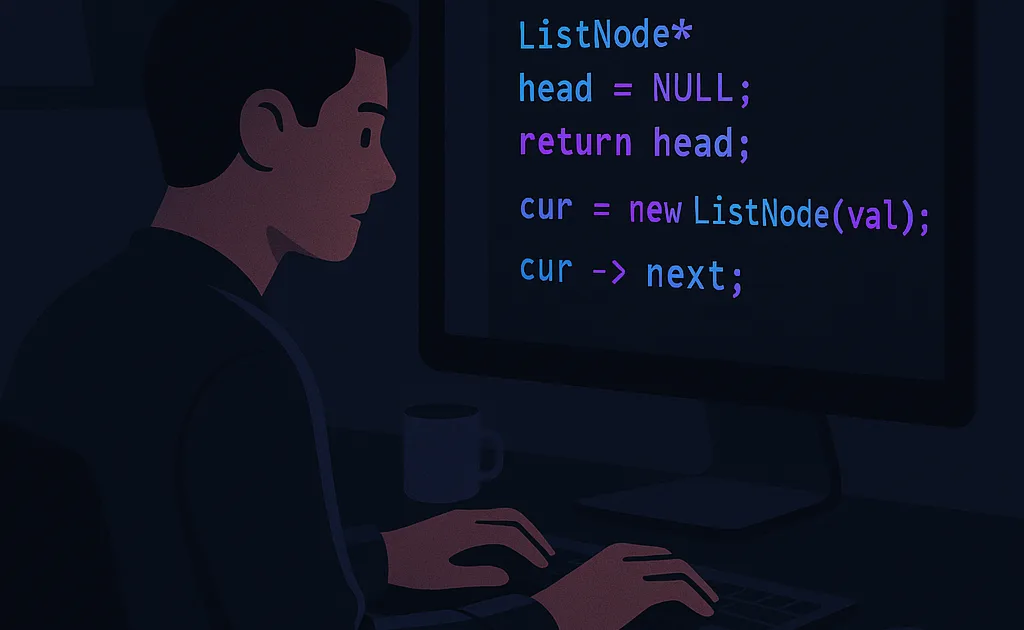
Linked lists are deceptively humbling. There's no fancy algorithm to memorise — just pointers, and pointers are exactly where careful people make careless mistakes. Reverse one under time pressure and you'll understand why interviewers love them: they test whether you can hold three references in your head without dropping one on the floor.
Three tricks solve most of them: the fast/slow pointer (Floyd's), the dummy head node, and in-place reversal. Get these into your fingers and linked-list rounds stop being scary.
Reverse in place
The one everyone gets asked. Three pointers, walk forward, flip each link:
function reverse(head) {
  let prev = null, curr = head;
  while (curr) {
    const next = curr.next;  // stash before you overwrite
    curr.next = prev;        // flip
    prev = curr;             // advance
    curr = next;
  }
  return prev;               // new head
}
Say the invariant out loud as you code: "prev is the reversed part, curr is what's left." That sentence alone prevents most bugs.
Fast & slow pointers
Two runners, one twice as fast. If there's a cycle, they collide. If there isn't, the fast one hits the end. Same trick finds the middle node in a single pass:
function hasCycle(head) {
  let slow = head, fast = head;
  while (fast && fast.next) {
    slow = slow.next;
    fast = fast.next.next;
    if (slow === fast) return true;
  }
  return false;
}
The dummy head idiom
Whenever a problem might delete or insert at the head, create a dummy node in front. Suddenly the head is no longer a special case, and a whole class of null-pointer bugs just… disappears. Return dummy.next at the end.
The five you should be able to do cold
- Reverse a linked list (iterative and recursive)
- Detect a cycle (and find where it starts)
- Merge two sorted lists
- Remove the nth node from the end (one pass, two pointers spaced n apart)
- Find the intersection of two lists
Common mistakes
- Losing the rest of the list because you reassigned
nextbefore saving it. Stash first. - Not handling the empty list or a single node. Check them explicitly.
- Forgetting to null-terminate the new tail after reversing a sublist. Silent infinite loops live here.
FAQ
Iterative or recursive reversal? Iterative is O(1) space; recursion costs O(n) on the call stack. Mention the trade-off — interviewers notice.
Why does the dummy head help so much? It removes the "what if we modify the head?" branch, which is where most edge-case bugs hide.
Linked lists sit right next to the core data structures and lead naturally into trees. Drill them with Aissence's coding copilot.
Put this into practice
Continue with the Aissence workflow this guide supports.