
25 Finance Interview Questions for Banking & Investment Roles
696 words · Reviewed for accuracy
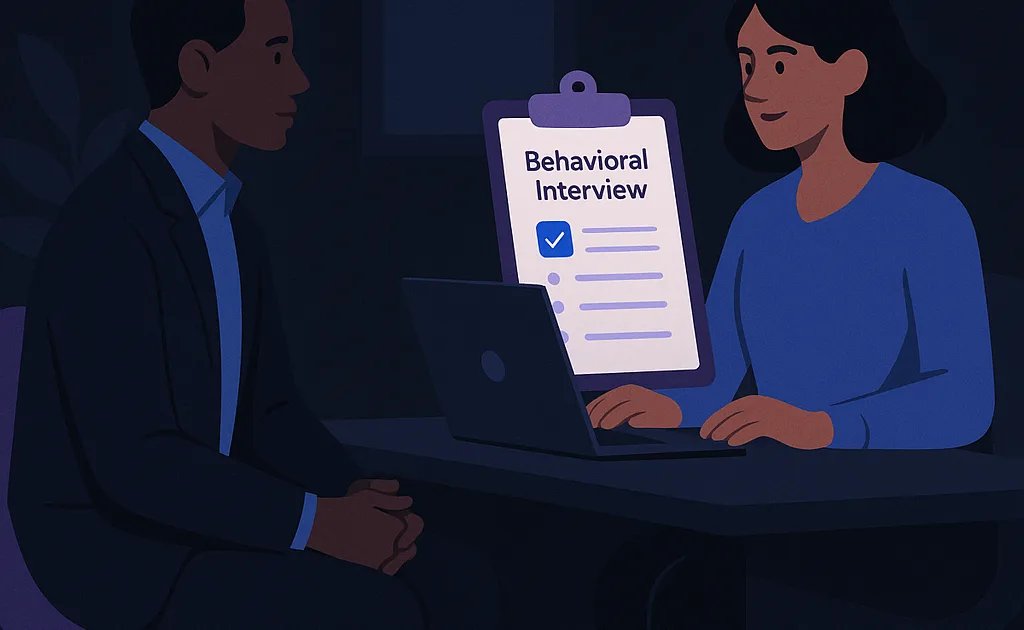
Finance interviews — whether for banking, corporate finance, or FP&A — test whether you understand how money moves through a business, not whether you've memorised definitions. Interviewers can spot rote learners instantly: they recite what a DCF is but freeze when asked why a change flows through the statements the way it does. Intuition is the whole game.
The questions that decide finance interviews are follow-ups. Anyone can define working capital. The hire-worthy candidate explains what happens to cash when a company grows fast, why depreciation affects all three statements differently, and when EBITDA misleads. Prepare for the second and third "why," not the first "what."
Here's how the evaluation works, the concepts grouped by theme, and a walkthrough of the classic three-statement question so you can see what good reasoning sounds like.
What interviewers are scoring
- Statement linkage. Do the income statement, balance sheet, and cash flow statement connect in your head as one system?
- Valuation intuition. Not formulas — judgment. What drives value, what breaks a DCF, when multiples are the wrong tool.
- Business sense. Can you talk about margins, capital allocation, and risk like someone who'd sit in on real decisions?
- Precision under pressure. Mental arithmetic and sanity checks, delivered without panic.
- Honest limits. "I'd verify that assumption" is a better answer than a confident guess.
The question bank, grouped
Accounting fundamentals: "Walk me through the three statements and how they connect." "If depreciation rises by ten, what happens to each statement?" "Why can a profitable company run out of cash?"
Valuation: "Walk me through a DCF." "When would you use comparable companies instead?" "What does a higher discount rate do, and what does it represent?" Know the meaning — risk and opportunity cost — not just the direction of the effect.
Judgment: "A company's revenue is growing but cash is shrinking. Where do you look first?" "What makes a good acquisition?" These have no single right answer; they're watching how you structure the hunt.
Fit: "Why this desk / team / industry?" Generic ambition answers are filtered out fast.
Worked example: the depreciation question
Listen to how a strong answer sounds — it's a narration of logic, not a recital:
"If depreciation goes up by ten, operating income falls by ten on the income statement. Assuming a tax rate, net income falls by less than ten because taxes drop too — so say net income falls by seven at a notional rate. On the cash flow statement, I start with that lower net income but add back the full ten of depreciation since it's non-cash, so cash from operations is actually up by three. On the balance sheet, PP&E drops by ten while cash rises by three, so assets are down seven — which balances against the seven drop in retained earnings. It balances, which is my check that the logic held."
See what happened there? They stated each hop, did the arithmetic out loud, and ended with a self-verification. That's the shape of every good technical answer: steps, numbers spoken, balance check.
Common mistakes
- Defining terms instead of explaining mechanisms — the interviewer's follow-up will expose this within a minute.
- Treating the cash flow statement as an afterthought. It's where sophisticated interviewers spend most of their time.
- Freezing on mental math instead of narrating estimates. "Roughly speaking" with stated assumptions beats silence.
- Claiming markets knowledge you can't sustain. If you mention following a sector, expect three questions deep on it.
FAQ
How technical should a corporate finance or FP&A interview get? Less deal mechanics, more business judgment — budget variance reasoning, forecast drivers, scenario thinking. The statement linkage questions still appear everywhere, so master those first.
Do I need to build a full model before the interview? You should be able to describe building one — structure, drivers, sanity checks — even if the interview never asks you to open a spreadsheet. The verbal walkthrough is what reveals real understanding.
Heading toward payments or lending roles? The fintech interview guide layers domain knowledge on top of these fundamentals. Drill the walkthroughs aloud with mock interview practice — statement questions only feel easy once you've said them out loud.
Put this into practice
Continue with the Aissence workflow this guide supports.