AI in Interviews: 2026 Trends & Tips
563 words · Reviewed for accuracy
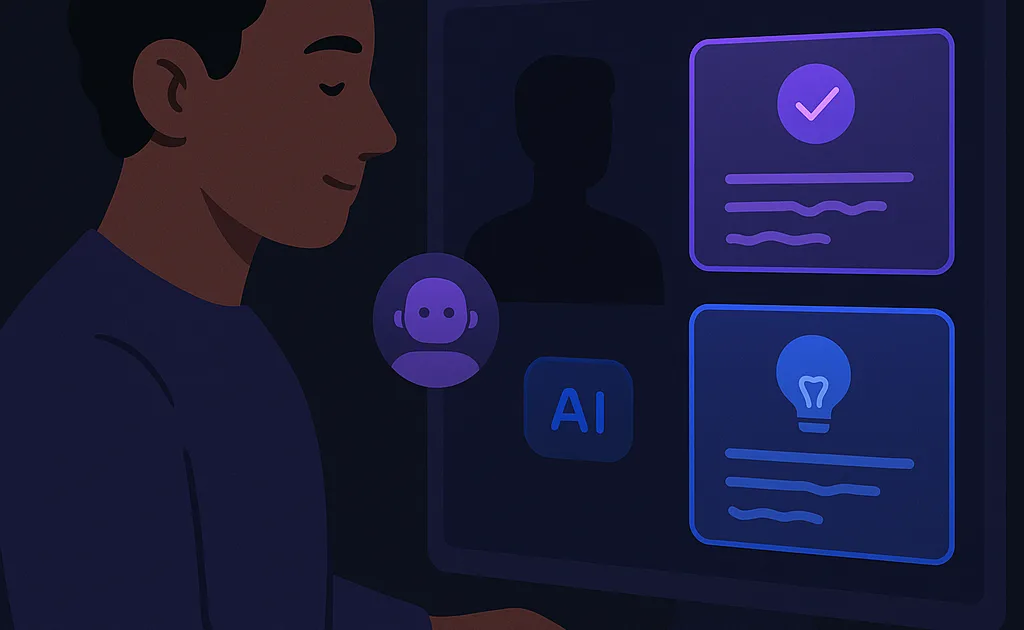
AI now sits on both sides of the interview table. Employers use it to screen resumes, transcribe interviews, score assessments, and schedule loops. Candidates use it to research companies, drill answers, and run mock interviews. Understanding both sides — honestly, without hype or panic — is now part of being a prepared candidate.
The key idea: the smart response to AI in hiring isn't fear or exploitation — it's adaptation. Use AI aggressively for preparation, be transparent about policies during live interviews, and double down on the skills AI can't fake for you: judgment, warmth, and thinking on your feet.
How employers are using it
- Screening and triage. Resume parsing and first-pass ranking — which means clear, specific, readable resumes matter more than ever.
- Async assessments. One-way video screens and AI-scored exercises as early gates. Treat them with full seriousness; they're real rounds.
- Interview support. Transcription and note-taking so interviewers can focus on you — assume everything you say is on the record, because it literally is.
- Integrity checks. Some platforms monitor for outside assistance during remote assessments. Policies vary by company, and violating them risks the offer.
How candidates should use it
Preparation is where AI earns its keep: generating practice questions, playing a skeptical interviewer, critiquing your stories, and compressing weeks of mock-interview scheduling into evenings. The AI behavioral practice guide has the full loop. During live interviews, follow the company's stated rules — many now explicitly define what's allowed. When in doubt, ask. "What's your policy on AI assistance during the process?" is a completely professional question in 2026, and asking it signals the exact integrity they hire for.
The skills that appreciate in value
As AI absorbs the mechanical parts of evaluation, the human parts get weighted heavier: live problem-solving narration, collaborative working sessions, behavioral depth, and rapport. Notice that none of these can be delegated to a tool on the day — they're you, trained. That's the real strategic conclusion: every current trend rewards genuine skill over clever shortcuts.
There's a subtle upside most candidates miss: as AI makes polished-but-hollow answers cheap to produce, authentic specificity becomes more valuable, not less. Interviewers are actively learning to spot generic fluency — and the candidate who answers with real names, real constraints, and real numbers stands out more sharply than ever. So lean into the un-fakeable: specific stories, honest "I don't know, but here's how I'd find out," live thinking they can watch happen in real time. AI raised the floor of average answers; it didn't touch the ceiling. And the ceiling is where offers get decided.
What to avoid
- Using undisclosed assistance in live interviews where it's prohibited. Beyond the ethics, detection and follow-up probing make it a bad bet.
- Keyword-stuffing your resume for screeners until no human would enjoy reading it. Both audiences matter.
- Panicking. The fundamentals — structured stories, clear thinking, warmth — are more durable than any screening technology.
FAQ
Will AI interviewers replace human ones? AI handles more of the early gates each year, but final decisions remain stubbornly human — hiring is a trust decision, and trust is still built face to face. Prepare for both audiences.
Should I mention my AI prep in the interview? If it comes up naturally ("I drilled this with mock interviews until the structure was automatic"), it reads as work ethic. Preparation has never been something to hide.