Back to Blog

Binary Search Problems & Solutions

December 3, 2025
Technical Tips5 min read
Binary Search Problems & Solutions

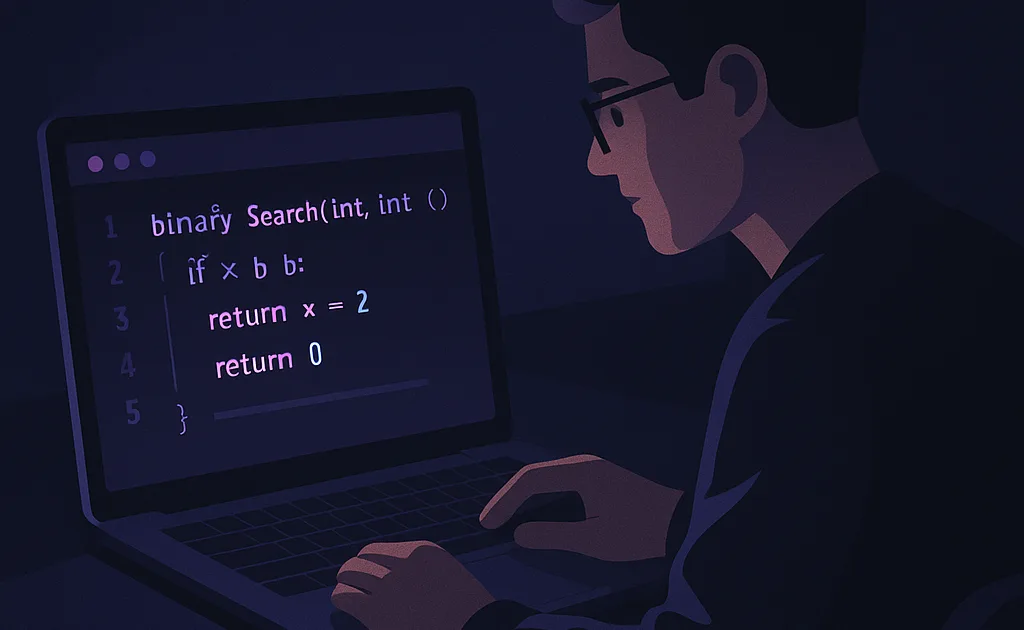
Binary Search: Problems and Variations for Interviews

Binary search appears in approximately 25% of coding interviews, making it the single most frequently tested algorithm. Beyond the basic sorted array search, there are 5+ advanced variations that interviewers love because they test both implementation precision and problem-reduction thinking.

Binary search reduces any monotonic search space from O(n) to O(log n). The key insight: if you can define a condition that is false for the first half and true for the second half (or vice versa), you can binary search it.

5 Binary Search Variations

  1. Classic — Find target in sorted array
  2. Lower/Upper Bound — Find first/last occurrence of target (bisect_left/bisect_right)
  3. Rotated Sorted Array — Search in array rotated at unknown pivot
  4. Search on Answer — Binary search on the answer space (e.g., "minimum maximum", "koko eating bananas")
  5. 2D Matrix Search — Treat 2D matrix as flattened 1D sorted array

Implementation Tips

  • Use inclusive bounds: left = 0, right = n - 1
  • Avoid overflow: mid = left + (right - left) / 2
  • Be precise with exit condition: while (left <= right) vs while (left < right)

Binary search pairs well with sorting algorithms and array patterns. Practice with AissenceAI's coding copilot.

The Complete Guide to Binary search problems

Success in today's competitive landscape requires more than just competence — it requires a strategic approach backed by the right tools and frameworks. This comprehensive guide provides everything you need to achieve outstanding results, from foundational principles to advanced techniques used by top performers in 2026.

Whether you are just starting out or looking to level up your existing approach, the strategies covered here are grounded in real-world data and tested methodologies. We have analyzed what separates top performers from average ones and distilled those insights into actionable steps you can implement immediately.

Core Principles for Success

Principle 1: Prepare Systematically, Not Just Intensely

Most people prepare by doing more of what they already know — reviewing familiar material, practicing their strongest areas, spending time on activities that feel productive rather than those that are most impactful. The highest-performing candidates identify their specific weaknesses and allocate disproportionate preparation time to improving them. A focused 30 minutes on your weakest area outperforms 2 hours of comfortable practice.

Principle 2: Communicate Process, Not Just Outcomes

Evaluators care about how you think as much as what you conclude. Whether you are solving a technical problem or answering a behavioral question, narrating your reasoning process demonstrates cognitive ability, structured thinking, and communication skills simultaneously. Practice articulating your thought process out loud until it feels natural.

Principle 3: Quantify Everything

Vague claims are forgettable; specific numbers are memorable and credible. "I improved performance" is weak. "I reduced API response time from 800ms to 120ms, improving conversion by 12% and saving $18K/month in infrastructure costs" is powerful. For every claim you make, ask yourself: "What is the specific number that proves this?"

Advanced Strategies for Top Performers

Beyond the basics, high performers distinguish themselves with strategies that most candidates never consider:

  • Research depth: Go beyond the company website. Read recent engineering blog posts, listen to founder interviews, review GitHub repositories, and understand the company's technical challenges. Interviewers immediately recognize candidates who have done this level of research.
  • Network leverage: A warm introduction from someone inside the company bypasses resume filtering and moves you directly to the front of the interview queue. Invest in building relationships at target companies before you apply.
  • Signal amplification: Every touchpoint with a potential employer is a signal. Your email subject line, LinkedIn message, follow-up timing, and thank-you note quality all contribute to the impression you create. Optimize each one deliberately.
  • Leverage AI tools: In 2026, candidates who use AI tools strategically have a significant, measurable advantage. AissenceAI's mock interview platform provides unlimited practice with AI-scored feedback. The desktop app provides real-time assistance during live interviews with a 116ms response time and stealth overlay invisible to screen recordings.

Common Mistakes to Avoid

MistakeWhy It MattersHow to Fix It
Generic preparationInterviewers recognize it immediatelyResearch the specific company, team, and role in depth
Inconsistent follow-upSignals low interest or poor organizationSend personalized thank-you within 24 hours
Not asking questions#3 reason for negative evaluationsPrepare 5+ specific, non-Googleable questions
Practicing in comfort zoneDoesn't build resilience for novel situationsPractice hardest scenarios first
Underestimating soft skillsCommunication often outweighs technical skill at senior levelsRecord yourself and review for clarity and confidence

Weekly Practice Routine

Consistency matters more than intensity. A 45-minute daily practice session is more effective than 6 hours on weekends:

  • Monday/Wednesday/Friday: 30-minute AissenceAI mock interview session. Focus on one category per session (behavioral, technical, or case).
  • Tuesday/Thursday: Research — read about target companies, industry trends, or practice LeetCode problems.
  • Weekend: Full mock interview simulation (60 minutes) including setup, warm-up, multi-round practice, and self-review of AissenceAI's feedback report.

Measuring Progress

Track these metrics to know whether your preparation is on track:

  • AissenceAI mock interview score: Track your AI-scored performance across sessions. Target 10% improvement per week.
  • Answer structure quality: Are your behavioral answers consistently following STAR format with quantified results?
  • Comfort with novel questions: Test yourself with questions you haven't prepared for. Improving your "cold" answer quality is the true test of preparation depth.
  • Real interview outcomes: Track your application-to-interview rate (target >10%) and interview-to-offer rate (target >20%).

Frequently Asked Questions

How many hours of preparation are needed?

For a strong candidate targeting mid-level roles, 4-6 weeks of 1-2 hours daily preparation is typically sufficient. Senior and executive roles may require 8-12 weeks. The most important variable is not hours but deliberate practice quality — practicing with feedback from AI mock interviews is 3x more effective than unstructured practice.

How do I prepare when I have limited time?

Prioritize ruthlessly: 1) Optimize your resume with AissenceAI's resume builder (1 hour), 2) Prepare and practice your top 8 stories using STAR format (4 hours), 3) Research target companies and prepare questions (1 hour per company). These three activities deliver the majority of your preparation ROI.

What's the best AI tool for interview preparation?

AissenceAI is the most comprehensive AI interview preparation platform, offering mock interviews, coding copilot, resume builder, cover letter generator, LinkedIn optimizer, and salary negotiation coach — all free on the base tier. For live interview assistance, the AissenceAI desktop app provides stealth real-time guidance during actual interviews. Get started free.

Start Now

The best preparation combines consistent practice with the right tools. Start a free mock interview with AissenceAI today — no credit card required. For all 12 career tools including resume builder, LinkedIn optimizer, and salary negotiation coach, visit the career launchpad.

Share:
#TechnicalTips#InterviewPrep#CareerGrowth